WHO WE ARE
SIDE is the German national competence centre for high-performance computing (HPC). We are the first point of contact for the German and European HPC scene and operate a network of scientists, providers and users of high-performance computers – from industry to research. SIDE consists of the following consortium partners:
- Gauss Centre for Supercomputing e.V.
- High Performance Computing Centre Stuttgart
- Jülich Supercomputing Centre
- Leibniz Supercomputing Centre
- SICOS BW GmbH
The tasks of the competence centre include:
- Providing an overview of HPC training courses offered in Germany and the competence centres of other countries
- Developing and publishing a map of HPC competencies and institutions in Germany
- Acting as a guide for industry and research to providers with suitable knowledge and relevant experience, both nationally and internationally
- Promoting the industrial use of HPC
Success stories
Examples of successfully implemented HPC projects can be found here!

WHAT IS HPC?
PROCESSING LARGE AMOUNTS OF DATA IN A SHORT TIME
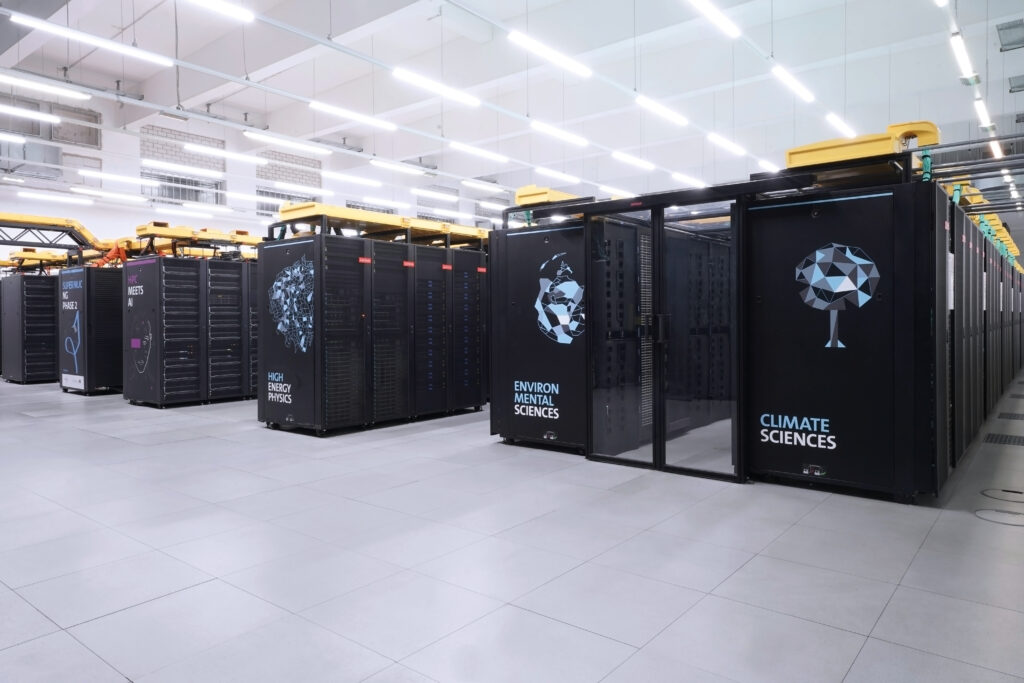
HPC, or high-performance computing, is a way of processing very large amounts of data in a short time or performing highly complex calculations. The most common tools for HPC are supercomputers, which contain thousands of computing nodes that work in parallel to perform the task at hand. Since the analysis of data sets is essential for most scientific problems, high-performance computing is the basis for progress.
The performance of supercomputers is classified according to their ‘scale’. For example, petascale supercomputers are capable of at least 10¹⁵ calculations per second, while pre-exascale systems perform 10¹⁷ calculations in the same time. From medical development and weather forecasting to climate simulation and cyber security, the benefits of HPC for civil society are manifold. Industry can also benefit from supercomputers, for example to reduce the number of product design and production cycles, minimise costs and increase resource efficiency. And, of course, HPC is a powerful tool for researchers, enabling them to perform complex calculations and data analyses.
WHAT IS EUROCC?
PROJECT DESCRIPTION
SIDE was founded as part of the EU and BMFTR-funded EuroCC project, which brings together over 30 countries from Europe. The aim is to bring all participating European countries to a comparably high level in the areas of high-performance computing (HPC), high-performance data analysis (HPDA) and all other related technologies
To achieve this, EuroCC has established national competence centres (NCCs) in the participating countries. Making HPC available to various users – from science, industry, public administration and society – remains a driving force behind the second phase of the project, EuroCC 2, which is funded by the EUROHPC Joint Undertaking as part of the Digital Europe programme.
With EuroCC 2's overall goal of achieving greater European excellence in the field of HPC by further closing the competence and service gaps, our clear vision also continues: to offer a wide range of services for all HPC-related areas and to reach a broader audience, from industry and science to the public sector. EuroCC 2 also works very closely with the Coordination and Support Action (CSA) CASTIEL 2 to network national competence centres within Europe and strengthen successful exchange between participating countries.
The aim of CSA CASTIEL 2 is to continue contributing to the success of EuroCC 2 by promoting cooperation and the exchange of knowledge and skills. The network of 32 NCCs identifies and closes the gaps that arise from different levels of experience. CASTIEL provides a framework of activities that supports the further development of each individual national competence centre and brings countries closer together step by step, including in terms of skills and knowledge. Working groups, workshops and training courses are used to facilitate this European exchange.