
Technical/scientific Challenge
Ozone, a protective compound in earth’s stratosphere, also occurs in the lowest layer of our atmosphere, the troposphere. Tropospheric ozone, though, is harmful to the climate, human health, and vegetation by reducing biomass, harvests, and biodiversity. Quantifying its global uptake by plants is crucial but challenging because it requires numerical modelling that correlates fine-resolution ozone measurements, plant specifics, and meteorological parameters, which are only available for individual sites and limited time periods, making quantification impractical and meaninglessly fragmented.
Solution
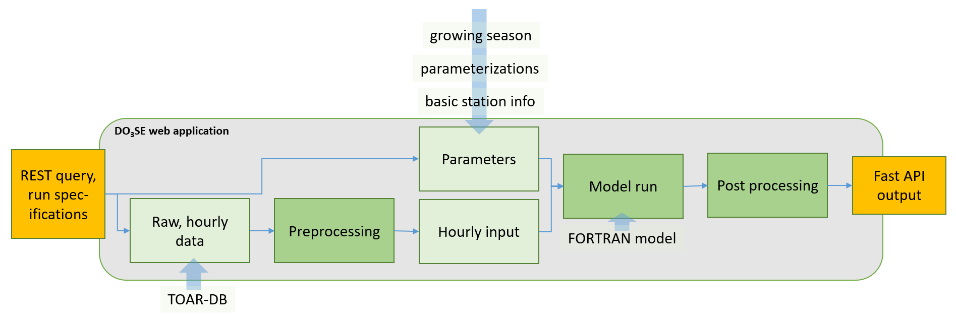
The TOAR data infrastructure solves the problem of fragmented data. It couples the TOAR database, which is hosted at JSC clouds and contains one of the world's largest collections of ground-based ozone measurements, with the meteocloud, a collection of meteorological data also at JSC, as inputs to the ozone deposition model DO3SE. The workflow of webDO3SE is shown in Figure 1. Via a web interface, users can easily access the data and perform impact estimates themselves in their browser. They select a site and a species by REST query to webDO3SE. Then, all the parameters and inputs needed to run the model are automatically gathered on-line. The model output is then provided to the user directly in the browser for further analysis.
Benefits
- Tor data combined with HPC resources and the meteocloud facilitates access to an unprecedented scope of tropospheric ozone data.
- WebDO3SE provides a unique interface for researching tropospheric ozone impact on vegetation.
- Studying tropospheric ozone at a global level empowers environmental agencies.
Industrial sector
Agriculture, Environment/climate/weather, Public services/Civil protection
Scientific partners involved
The Tropospheric Ozone Assessment Report (TOAR) is an international activity under the International Global Atmospheric Chemistry project, which aims to assess the global distribution and trends of tropospheric ozone and to provide data that are useful for the analysis of ozone impacts on health, vegetation, and climate. The TOAR data centre provides access to the TOAR database, which compiles air quality monitoring data from thousands of sites around the world.
Scientific impact
As climate change progresses, the greenhouse gases and compounds that beget tropospheric ozone will also likely increase. Historically, studying the far-ranging impacts of tropospheric ozone on food security, carbon sequestration, timber production, and protection against soil erosion, avalanches, and flooding has been hindered by fragmented access to data. Nevertheless, HPC infrastructure combined with TOR data mitigates that fragmentation and enables the scaling of scientific studies to support public entities.
The TOAR tool, webDO3SE, is currently being used for a global deposition model intercomparison study and will in the future provide an unprecedently global assessment of ozone deposition of vegetation – the extent to which plants absorb and mitigate tropospheric ozone. Once webDO3SE is well established, it can also be used by environmental agencies to estimate tropospheric ozone-related crop damage and other negative impacts on vegetation. Over time the impacts of tropospheric ozone as well as any mitigation policies can be measured, tracked, and more accurately modeled to maximize future environmental and societal benefit.