
On December 2, 2024, an exciting event focusing on the diverse applications of high-performance computing (HPC) took place at the High-Performance Computing Center Stuttgart (HLRS) . Under the mottoServices & Applications for Industry and Public Institutions" the event offered comprehensive insight into current developments, practical applications, and financing options for HPC projects. The forum was held as part of the European EuroCC project, which supports national competence centers for high-performance computing (HPC), such as the German National Competence Center (NCC), throughout Europe. The forum was organized jointly by HLRS and Sicos BW on behalf of the German NCC. The other members of the NCC — the Jülich Supercomputing Centre (JSC) and Leibniz-Rechenzentrum (LRZ) — were represented as participants.
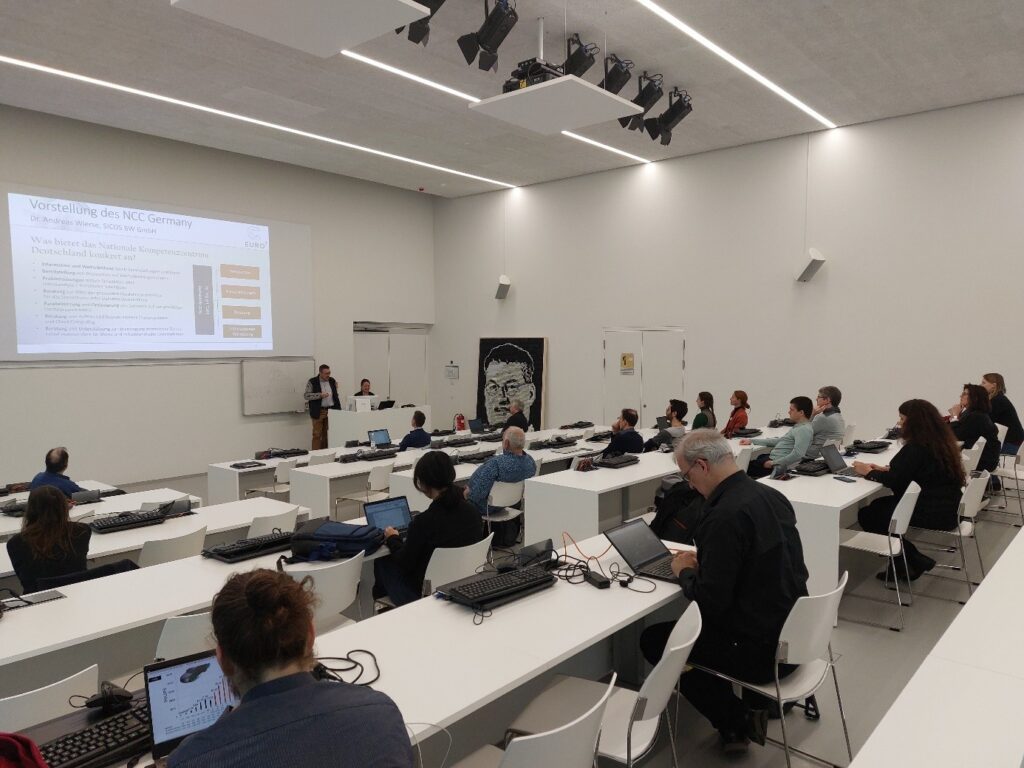
Welcome and introduction
Dr. Andreas Wierse opened the event with a short welcome and presented the program for the day. He then gave an informative introduction to the German National Competence Center for HPC. This presentation provided participants with an overview of the center's goals and tasks.
Industry use cases – from water management to defossilization
The morning was dominated by examples of practical applications of HPC from industry. In the first session, experts presented how HPC is enabling innovative solutions such as:
- Dr. Pavel Apanasevich (hydrograv GmbH) explained the use of supercomputing to optimize water management facilities.
- Dr. Benedetto Risio (RECOM Services GmbH) showed how HPC supports industry in defossilizing its energy systems.
- Dr. Max Gaedtke (cloudfluid) impressed with examples of multiphysical flow simulations on high-performance GPUs.
After a short coffee break, further use cases followed:
- Lukas Kriete (Kimoknow) explained the use of zero-shot transformer models for scalable catalog searches based on CAD data.
- Dr. Johanna Berndt (Grunetal) presented innovative solutions for scalable data connectivity and storage solutions.
- Dr. Xin Liu (Jülich Supercomputing Centre) presented a proof of concept for the use of AI in stock trading.
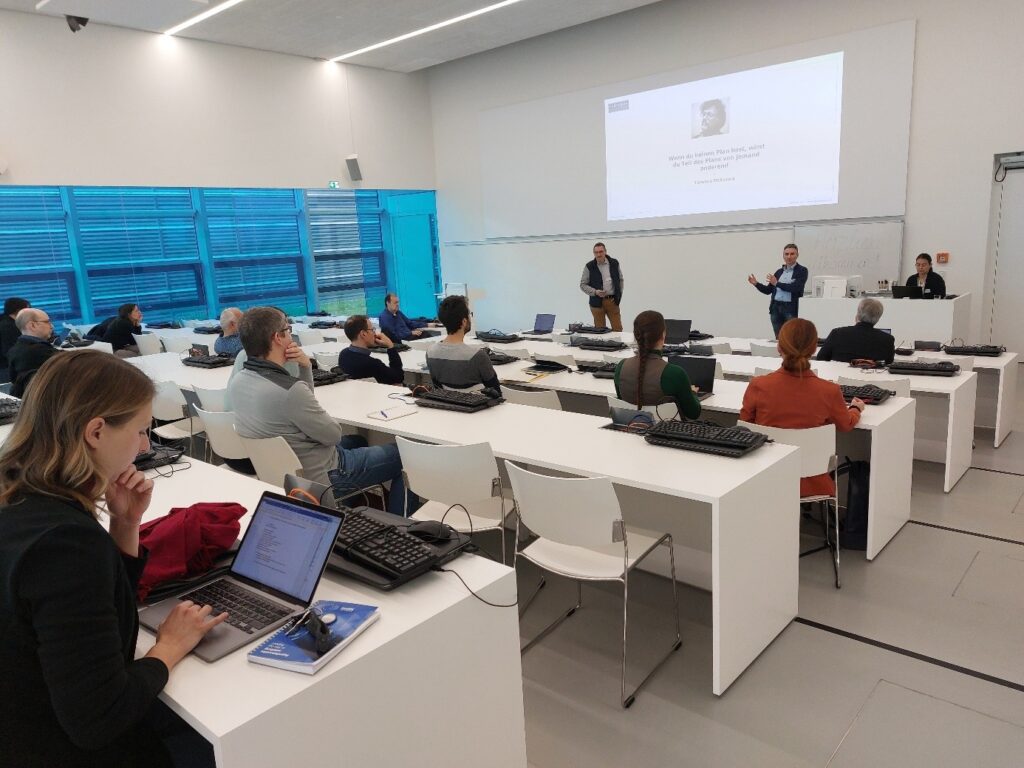
Funding and public use cases
After a joint lunch break, the focus shifted to funding opportunities for HPC projects. Josephine Stemmer, Dr. Andreas Wierse and Dr. Nadja Schauffler outlined specific ways to finance feasibility studies and projects, including FFplus and BEGIN HPC+.
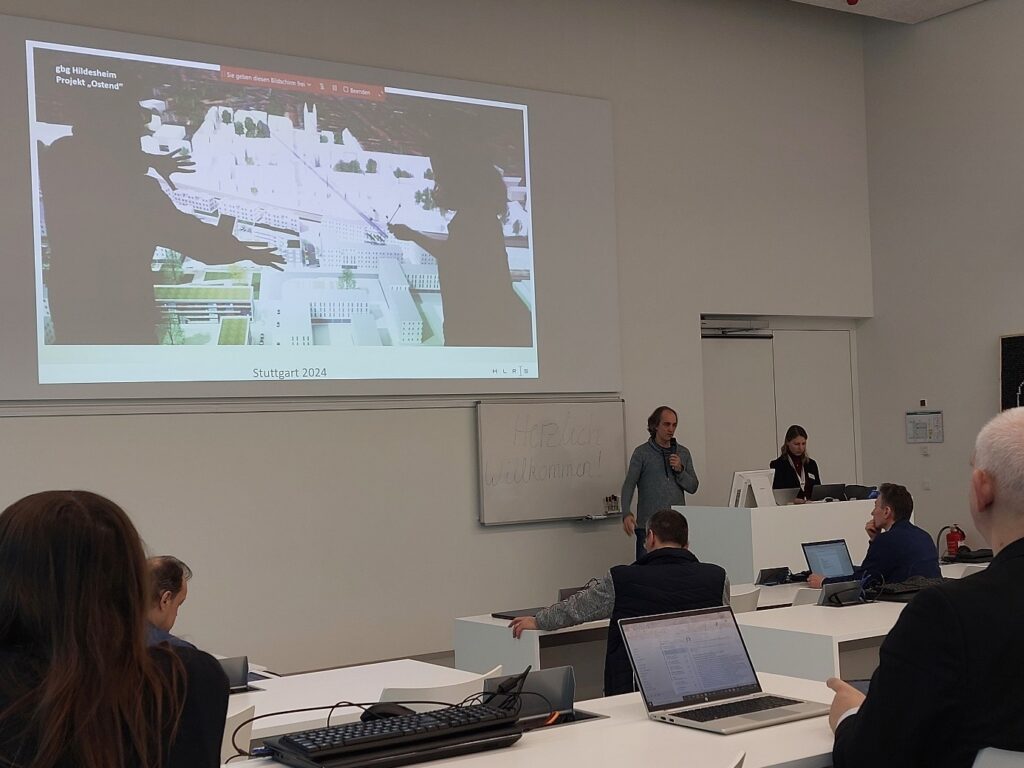
Use cases in the public sector were then presented. Led by Dr. Uwe Wössner, the visualization department at HLRS demonstrated how digital twins can support the energy transition and traffic planning. A particularly impressive presentation on conflict resolution in bicycle and pedestrian traffic was given by Marko Djuric (HLRS).
Disaster control and networking
After another break, the topic of disaster control was addressed. Dr. Ralf Schneider (HLRS) showed how computer-aided models can provide fast and effective emergency aid in crisis situations.
Finally, participants had the opportunity to exchange ideas with experts and experience a CAVE demo led by Dr. Uwe Wössner .
Conclusion
The event provided an excellent overview of the diverse applications of HPC – both in industry and in the public sector. The combination of technical presentations, practical examples, and networking opportunities was rated positively by all participants. Of particular note were the questions and discussions after each session, which were characterized by lively debates and numerous ideas. One example of this is the question: “How should models for stock trading be developed when trading is increasingly being taken over by robots?”
HLRS once again underscored the leading role of the German national competence center and the EuroCC project in the HPC landscape and showed how these players are actively contributing to the further development of technologies and their use. Participants were able to take away many valuable ideas to advance their own projects. We look forward to the next forum in 2025!